Quick answer: The Ridge is the wide open square at the heart of Shimla, running east to west above the Mall, which it meets at Scandal Point. It is the town’s cultural hub, home to Christ Church, the State Library and statues of national leaders, and the venue for Shimla’s summer festival and government functions. It is open all the time with no entry fee. Snow falls in some winters, mostly in January and February; India Meteorological Department normals put Shimla’s average January low at about 2°C.
The Ridge at a glance
| Detail | What we verified (October 2026) |
|---|---|
| Location | Central Shimla, running east to west beside and above the Mall |
| Altitude | About 2,206 m (7,238 ft) |
| Entry fee and timings | None; it is an open public space |
| Landmarks | Christ Church, State Library, statues, Scandal Point (west), Lakkar Bazaar (east) |
| Vehicles | Not allowed; reach it on foot or by the lift from the Cart Road |
| Snowfall | In some winters, mostly January and February |
| Time needed | One to two hours, more with the Mall |
What to see on the Ridge
The Ridge is a broad, open promenade on the top of the town. At its western end it joins the Mall at Scandal Point; at its eastern end it leads into Lakkar Bazaar, the wooden-crafts market. Himachal Pradesh Tourism describes it as Shimla’s cultural hub, and on clear days it gives views of the snow peaks to the north.
- Christ Church: the yellow neo-Gothic church, consecrated in 1857 and usually described as the second-oldest church in north India.
- The State Library: a Tudorbethan-style building, one of the Ridge’s best-known colonial façades.
- Statues: of Mahatma Gandhi, Indira Gandhi, Dr Y. S. Parmar (the first Chief Minister of Himachal Pradesh) and, more recently, Atal Bihari Vajpayee.
- Lakkar Bazaar: at the eastern end, known for wooden souvenirs and Himachali woollens.
- The Mall below: the Mall Road, with the Town Hall and the Gaiety Theatre, is a few steps down.
History and the water tanks below
The Ridge took shape as the main public square of British Simla, when the town was the summer capital of British India, and many of the buildings around it date from that period. It is more than a promenade: large underground tanks beneath the Ridge, built in the 1880s with lime mortar and holding about one million gallons, still store part of the town’s water supply, according to Himachal Pradesh Tourism and published records.
An earlier version of this article described the Ridge as an open road “on Mall Road”. The Ridge is a separate open space above the Mall; the two meet at Scandal Point.
Events and festivals
The Ridge is Shimla’s main venue for government functions, fairs and public celebrations. The best-known event is Shimla’s annual summer festival, with folk dance, music and cultural programmes. Published sources place it in April or May, but dates vary from year to year and are announced by the district administration, so check the current schedule before planning a trip around it. An earlier version of this article said the festival is a five-day event held every year since the 1960s; we could not confirm those details, so they have been removed.
Snowfall and temperature
Shimla’s weather on the Ridge follows the town’s climate. India Meteorological Department normals for Shimla (1991–2020) give:
| Month | Average high | Average low |
|---|---|---|
| January | 9.3°C | 1.7°C |
| May | 23.0°C | 13.6°C |
| June | 23.8°C | 15.1°C |
| July | 21.3°C | 14.6°C |
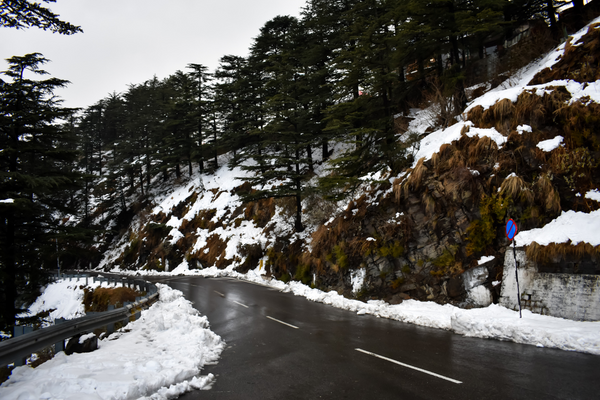
Shimla averages about 99 cm of snow a year, almost all of it in January and February, with a little in December and March, according to the same records. Snow is not guaranteed in any given year, and in recent years it has tended to arrive later, in January or early February, rather than December. The coldest temperature on record is −12.2°C, on 13 December 1963.
When it snows, the Ridge, Christ Church and the hills around turn white and the square fills with visitors. Snow can also close roads into Shimla for a while, so check road conditions before you travel.
Best time to visit
- March to June: pleasant days, the busiest tourist season and, often, the summer festival.
- July to September: the rainy season, with mist and heavy showers.
- October and November: clear, crisp days and good mountain views.
- December to February: cold, with a chance of snow. Christmas and New Year are very crowded.
How to reach the Ridge
- On foot: From anywhere on the Mall, walk up to Scandal Point. Private vehicles are not allowed on the Ridge or the Mall.
- By the lift: HP Tourism runs a lift from the Cart Road up to the Mall, next to a large car park. From the top, it is a short walk to the Ridge.
- By train: Shimla station is the terminus of the Kalka–Shimla railway. Take a taxi towards the lift, then walk up.
- By air: Shimla Airport at Jubbarhatti is about 23 km from the city, according to Himachal Pradesh Tourism.
Places to visit nearby
Jakhu Temple, on Shimla’s highest hill, is about 2.5 km uphill from the Ridge, according to Himachal Pradesh Tourism. Kali Bari Temple is a short walk from Scandal Point.
Frequently asked questions
Does it snow on the Ridge in Shimla?
In many winters, yes, mostly in January and February. Snow is not guaranteed every year.
What is the temperature in Shimla in winter?
India Meteorological Department normals give an average January high of about 9°C and an average low of about 2°C.
Is there an entry fee for the Ridge?
No. It is an open public square, open at all times.
Can cars go on the Ridge?
No. Vehicles are not allowed on the Ridge or the Mall. Walk up or use the lift from the Cart Road.
What is under the Ridge?
Large water tanks built in the 1880s, which still store part of Shimla’s water supply.
Checked in October 2026 against Himachal Pradesh Tourism’s Shimla page, India Meteorological Department climate normals for Shimla, the Shimla district administration’s transport information and published records of the Ridge.