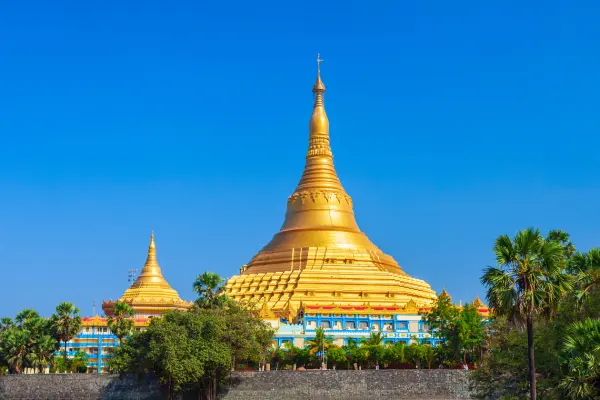
Quick answer: The Global Vipassana Pagoda is a huge golden meditation dome at Gorai, on the north-western edge of Mumbai, built in gratitude to the Burmese Vipassana teacher Sayagyi U Ba Khin and modelled on the Shwedagon Pagoda in Myanmar. Its stone dome holds about 8,000 meditators and enshrines bone relics of the Buddha. As of October 2026, the pagoda’s official website lists it as open every day from 9 am to 7 pm, with free entry and free guides.
Global Vipassana Pagoda at a glance
| Detail | What to know |
|---|---|
| Location | Gorai, Borivali West, Mumbai, between Gorai creek and the Arabian Sea |
| Timings | 9 am to 7 pm, every day (official website, October 2026) |
| Entry fee | Free; no charge for guides |
| Inaugurated | 8 February 2009, by the then President of India, Pratibha Patil |
| Dress and rules | No shorts or skirts above the knee, no bare shoulders; no outside food since 1 March 2024; no photography inside the dome and visitors’ gallery |
| Best time to visit | November to February; mornings or late afternoons |
| Time needed | Two to three hours, including a short meditation session |
What is the Global Vipassana Pagoda?
The pagoda is a monument and meditation hall for Vipassana, the meditation technique taught in the tradition of Sayagyi U Ba Khin, a Vipassana teacher who was also the first Accountant-General of independent Burma (now Myanmar). His student S.N. Goenka, who taught Vipassana in India from 1969 and was awarded the Padma Bhushan in 2012, built the pagoda as a tribute to his teacher. The project was funded entirely by voluntary donations.
The shape is Burmese, copied from the Shwedagon Pagoda in Yangon. The main dome is about 29 metres high, and the hall inside covers more than 6,000 square metres without any supporting pillars. The pagoda describes it as the world’s largest hollow stone masonry structure containing relics of the Buddha.
History
- 1997: Planning begins.
- 2000: Construction starts; S.N. Goenka lays the foundation.
- 29 October 2006: Bone relics of the Buddha are enshrined in the central locking stone of the main dome. The relics were originally found in a stupa at Bhattiprolu in Guntur district, Andhra Pradesh, and were donated by the Mahabodhi Society of India and the Prime Minister of Sri Lanka.
- November 2008: The dome is structurally complete.
- 8 February 2009: President Pratibha Patil inaugurates the pagoda.
- 29 September 2013: S.N. Goenka dies in Mumbai, aged 89.
An earlier version of this article said the pagoda opened to visitors in 2009 after the two smaller domes were finished in 2008. We could confirm the inauguration date but not the separate completion date of the smaller domes, so we now give the official milestones only.
Architecture
- Foundation and dome: the foundation is basalt rock, and the dome is built of sandstone brought from Rajasthan, with no pillars inside the hall.
- Gold: the spire is covered in real gold; the rest of the pagoda is painted gold. The ornamental umbrella on the spire was donated by the people of Myanmar.
- Doors and gates: the main wooden doors were hand-carved in Myanmar. Gate No. 1, one of the largest sliding doors, is carved from Myanmar teak, and the Myanmar Gate, with Burmese designs, honours Burma and Sayagyi U Ba Khin.
An earlier version of this article gave the total height as 96.12 metres and said each sandstone block weighs 600 to 700 kg. Published figures for the height differ, and we could not confirm the block weight, so we have not repeated these numbers.
What to see and do
- Visit the main dome. Only old Vipassana students (those who have completed a course) may meditate inside the main dome. Other visitors see it from the visitors’ gallery, where free leaflets are available.
- Try a short Anapana session. Free Anapana (breath-awareness) sessions run continuously from 10 am to 6:30 pm in the North Pagoda, near the Buddha’s relics. They are open to anyone fit and over 10 years old. You must stay for the whole session, keep silent and switch off your phone. The website describes the session as a 10-minute session in one place and as a 20-minute Mini-Anapana in another, so allow about 20 minutes.
- See the galleries. A painting gallery shows people who benefited from Vipassana in the Buddha’s time; a video gallery shows free short films of about 17 minutes in Hindi and English; and a photo gallery records the pagoda’s construction. The Journey of Dhamma Experiential Gallery opens on weekends and holidays from 1 pm to 5 pm.
- Walk the campus. Look for the North and South Pagodas, the Buddha statue, the Ashoka Pillar with its fountain and lotus pond, the Bell Tower (visitors strike the bell on the way out) and the Gong Tower.
- Join a course. Old students can attend one-day courses at the pagoda. Ten-day residential courses are held at Dhamma Pattana, the meditation centre on the same campus near the South Pagoda. Like all courses in this tradition, they are run on donations from past students rather than fees. Apply well in advance.
Rules for visitors
According to the pagoda’s official website (October 2026):
- Shorts, skirts above the knee and clothes that leave the shoulders bare are not allowed.
- Outside food has not been allowed on campus since 1 March 2024; there are food courts on site.
- Intoxicants, including cigarettes, pan and chewing tobacco, are prohibited.
- Photography and video are not allowed inside the main dome or the visitors’ gallery.
- Foreign visitors must carry identity proof such as a passport.
How to reach the Global Vipassana Pagoda
- Via Gorai creek (from Borivali): Take a Western line train to Borivali, exit on the west side, and take a BEST bus or an auto-rickshaw (about 4 km) to the Gorai jetty. Ferries cross Gorai creek; the pagoda’s website names a ferry landing at the EsselWorld jetty, from which you follow signs to the pagoda. Check the last ferry back before you cross.
- By road (via Mira-Bhayandar): Drive north on the Western Express Highway past Dahisar, turn left at the Mira-Bhayandar crossing, and follow the signs through Bhayandar and Uttan towards Gorai and the pagoda. The pagoda’s website puts the domestic airport about 42 km away by this route.
- By bus from Bhayandar: A municipal bus from Bhayandar (West) runs towards the pagoda and Water Kingdom.
Ferry timings and fares, and bus route numbers, change; check them locally or on the pagoda’s website before you travel.
Places to visit nearby
- Water Kingdom: The water park next door; see our Water Kingdom guide.
- EsselWorld: The neighbouring amusement park has been closed since April 2022; our EsselWorld page explains its status.
- Aksa and Marve beaches: Across the creek on the Malad side; see our Aksa Beach guide. Swimming there is unsafe.
- Kanheri Caves: For older Buddhist heritage in Mumbai, visit the rock-cut Kanheri Caves in Sanjay Gandhi National Park.
Frequently asked questions
What are the Global Vipassana Pagoda timings?
As of October 2026, the official website lists 9 am to 7 pm, every day.
Is there an entry fee?
No. Entry and guides are free.
Can anyone meditate inside the main dome?
No. Only old students who have completed a Vipassana course may meditate inside the dome. Other visitors can join the free Anapana sessions in the North Pagoda.
Who built the Global Vipassana Pagoda?
It was built through voluntary donations as a tribute to Sayagyi U Ba Khin by his student S.N. Goenka. Construction began in 2000 and the pagoda was inaugurated on 8 February 2009.
Is photography allowed?
Not inside the main dome or the visitors’ gallery. Follow signs and staff instructions elsewhere on the campus.
Details checked in October 2026 against the Global Vipassana Pagoda’s official website (timings, rules, Anapana sessions, directions and campus features) and published records of its construction. Timings and ferry services can change, so check before you go.