Quick answer: ISKCON Juhu, the Sri Sri Radha Rasabihari temple at Hare Krishna Land, is a white-marble Krishna temple a short walk from Juhu Beach in Mumbai. It was inspired by ISKCON founder A.C. Bhaktivedanta Swami Prabhupada and opened on 14 January 1978. As of October 2026, the temple’s website lists it as open every day from 4:30 am to 1 pm and from 4:15 pm to 9 pm, and no entry fee is listed.
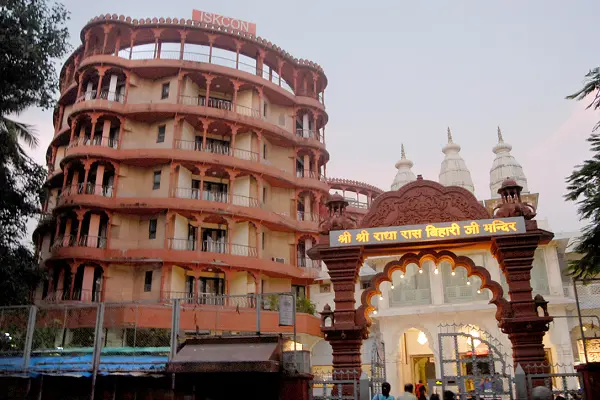
ISKCON Juhu at a glance
| Detail | What to know |
|---|---|
| Official name | Sri Sri Radha Rasabihari Temple, ISKCON Juhu (Hare Krishna Land) |
| Location | Hare Krishna Land, Juhu, Mumbai, close to Juhu Beach |
| Timings | 4:30 am to 1 pm and 4:15 pm to 9 pm, all days (ISKCON Juhu website, October 2026) |
| Closed | Daily from 1 pm to about 4:15 pm, and overnight |
| Entry fee | None listed for darshan |
| Best time to visit | Morning or evening arati; November to February for cooler weather |
| Time needed | One to two hours |
About the temple
ISKCON Juhu belongs to the International Society for Krishna Consciousness (ISKCON), the Hare Krishna movement founded by A.C. Bhaktivedanta Swami Prabhupada. The temple stands on a four-acre plot known as Hare Krishna Land, a stone’s throw from Juhu Beach. It is often called the Hare Rama Hare Krishna temple or the Radha Rasabihari temple.
The temple’s altars hold three sets of deities:
- Sri Sri Gaura-Nitai (Chaitanya Mahaprabhu and Nityananda);
- Sri Sri Radha Rasabihari (Radha and Krishna), the presiding deities;
- Sri Sri Sita Rama Laxman Hanuman.
The busiest day of the year is Janmashtami, Krishna’s birthday. Other major festivals include Radhashtami, Ram Navami, Govardhan Puja and the Jagannath Rath Yatra. Expect long queues and crowd controls on festival days.
History of ISKCON Juhu
In the early 1970s Juhu was a remote area on the edge of the city. Prabhupada acquired the plot despite years of legal and practical obstacles, and the Radha Rasabihari deities were first worshipped in a small shack while the temple was planned. Prabhupada asked for a spacious marble temple with domes more than a hundred feet high and a silver and teakwood throne for the deities.
Prabhupada died in November 1977. His disciples inaugurated the temple two months later, on Makar Sankranti, 14 January 1978, and the temple marks its anniversary each January.
Architecture
The temple is built of white marble in a traditional Hindu temple style, with domed towers rising above the main hall. The main hall is large enough to hold big festival crowds. An earlier version of this article gave the tower height as almost 100 feet; Prabhupada’s instruction was for domes of more than a hundred feet, but we could not confirm the finished height from an official source, so we have not stated one.
What to see at ISKCON Juhu
- The temple hall and aratis. The day starts with Mangala Arati at 4:30 am and ends with Shayana Arati at 8:30 pm. The temple’s website lists, in order: Tulsi Puja (5 am), Sringar Darshan (7:15 am), Guru Puja (7:25 am), a Bhagavatam class (8 am), Raj Bhoga Arati (12:30 pm), Usthapana Arati (4:15 pm), Sandhya Arati (7 pm) and a Bhagavad Gita discourse (7:30 pm).
- Prabhupada Quarters. Prabhupada stayed in these rooms on the fifth floor of the west tower of the guesthouse during two visits in 1977, and translated parts of the Srimad Bhagavatam here. His palanquin, dictaphone and vyasasana (seat) are on display. The quarters are open to all visitors from 5:30 pm to 8:30 pm.
- Govinda’s restaurant and bakery. The complex has a large vegetarian restaurant, Govinda’s, and a bakery, along with a sweet stall and prasadam counter.
- Book and gift shops. Stalls sell books on Krishna consciousness, devotional items and gifts.
- Library, diorama and halls. The complex also lists a library, a diorama, a recently renovated auditorium and multipurpose halls that can be hired for events.
- Guesthouse. A twin-towered, seven-storey guesthouse lets visitors stay on site and join the daily programme. Book well ahead for festival dates.
An earlier version of this article gave specific figures for the restaurant’s seating, the guesthouse’s room count and the capacity of each hall, and listed the cuisines served. We could not confirm these on the temple’s website, so we have removed them; contact the temple for current details.
ISKCON Juhu timings and entry fee
As of October 2026, ISKCON Juhu’s website lists the temple as open every day:
- Morning: 4:30 am to 1 pm
- Evening: 4:15 pm to 9 pm
- Closed: 1 pm to about 4:15 pm, and from 9 pm until the next morning
No entry fee is listed for darshan. Timings can change on festival days, so check the temple’s website (iskconmumbai.com) or call the temple office before you go. The temple also streams live darshan online.
Tips for visiting
- Dress modestly, as at any place of worship, and be ready to leave your footwear at the shoe counter.
- Arrive early for Mangala Arati or the evening Sandhya Arati if you want to see the temple at its liveliest.
- On Janmashtami and other big festivals, expect very large crowds, queues and security checks.
- Follow the instructions of temple volunteers about photography inside the hall.
How to reach ISKCON Juhu
- By train: The nearest Western line stations are Vile Parle, Andheri and Santacruz; take an auto-rickshaw or a BEST bus to Juhu.
- By metro: D.N. Nagar, served by Metro Lines 1 and 2A, is the nearest metro station to the Juhu area; continue by auto-rickshaw.
- By air: The temple is a short drive from Chhatrapati Shivaji Maharaj International Airport, especially from the domestic terminal (T1). Allow extra time in traffic.
Places to visit near ISKCON Juhu
- Juhu Beach: A few minutes’ walk away; see our Juhu Beach guide for street food and sunset tips.
- Prithvi Theatre: The well-known Juhu theatre, covered in our Prithvi Theatre guide.
- Versova Beach: A quieter beach and fishing village to the north; see our Versova Beach guide.
- Siddhivinayak Temple: For another of Mumbai’s major temples, see our guide to Shree Siddhivinayak Temple in Prabhadevi.
Frequently asked questions
What are the ISKCON Juhu temple timings?
As of October 2026, the temple’s website lists 4:30 am to 1 pm and 4:15 pm to 9 pm, every day. It is closed in the afternoon and overnight.
Is there an entry fee for ISKCON Juhu?
No entry fee is listed for darshan. The restaurant, guesthouse, shops and hall bookings are paid separately.
When was ISKCON Juhu built?
Prabhupada acquired the land in the early 1970s, and his disciples inaugurated the temple on 14 January 1978, two months after his death.
Which deities are worshipped at ISKCON Juhu?
Sri Sri Radha Rasabihari, Sri Sri Gaura-Nitai, and Sri Sri Sita Rama Laxman Hanuman.
Can visitors see Prabhupada’s rooms?
Yes. Prabhupada Quarters, on the fifth floor of the guesthouse’s west tower, are open to visitors from 5:30 pm to 8:30 pm.
Details checked in October 2026 against ISKCON Juhu’s official website (timings, deities, history, Prabhupada Quarters) and ISKCON News reporting on the temple’s anniversary. Temple timings change on festival days, so check before you go.