Quick answer: Mahalaxmi Dhobi Ghat is a huge open-air laundry next to Mahalaxmi railway station in South Mumbai, built in 1890 and often called the world’s largest outdoor laundry. Thousands of washers (dhobis) work in rows of concrete wash pens for 18 to 20 hours a day, washing clothes and linen from across the city. It is a working laundry, not a ticketed attraction: there is no official entry fee or opening time, and daytime is the best time to see it.
Dhobi Ghat at a glance
| Detail | What to know |
|---|---|
| Location | Beside Mahalaxmi station (Western line), near the Saat Rasta roundabout, Mahalaxmi, Mumbai |
| Built | 1890 |
| Working hours | About 18 to 20 hours a day; visiting in daylight is best |
| Entry fee | No official ticket; it is a working laundry and residential area |
| Best time to visit | October to March, in the morning when washing is in full swing |
| Time needed | 30 minutes to view from outside; about an hour on a guided walk |
What is Dhobi Ghat?
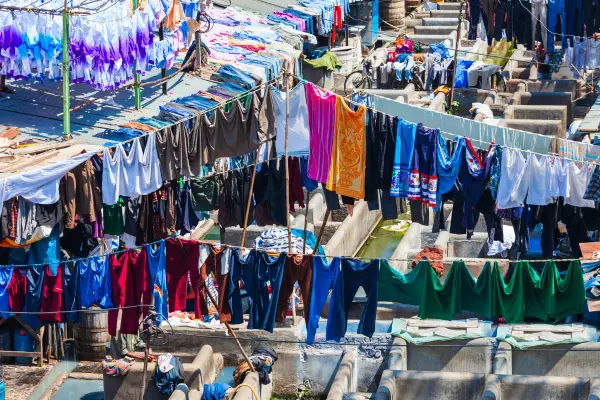
“Dhobi ghat” is a general term used across India for a place where many washers work together. Mumbai’s best-known one, at Mahalaxmi, is a large grid of open-air concrete wash pens, each with its own flogging stone, where clothes are soaked, beaten, scrubbed, rinsed and bleached by hand.
The work is organised in stages. Clothes are collected from across the city, sorted, washed in the pens, dried on long lines of rope strung across the ghat, ironed and bundled, and sent back to their owners. Each item is marked so it can be traced to the right customer. Some of the better-off dhobis have installed large washing and drying machines, but much of the washing is still done by hand.
Estimates of the scale vary. The Dhobi Kalyan & Audhyogik Vikas Cooperative Society, which represents the washermen, has put the number of people working here at more than 7,000, washing over one lakh (100,000) items of clothing a day, with an annual turnover of around ₹100 crore. The dhobis’ biggest customers include neighbourhood laundries, garment dealers, wedding decorators and caterers, and mid-sized hotels and clubs. The old version of this article said about 5,000 dhobis and 700 families work here; figures differ between sources, and the work has been passed down through generations of the same families.
History of Dhobi Ghat
The Mahalaxmi Dhobi Ghat was built in 1890, during British rule, and much of its basic layout of wash pens and drying lines has changed little since. The model was later copied elsewhere: the British built a dhobi ghat in Calcutta (now Kolkata) in 1902.
In 2011 the dhobis set a Guinness World Record for the most people hand-washing clothes simultaneously at a single location, when 496 washers took part, as reported by the news agency AFP.
The ghat has also become part of popular culture. Kiran Rao’s Hindi film Dhobi Ghat (also released as Mumbai Diaries) takes its name from these laundries. The old version of this article listed other films said to have been shot here; we could not confirm them, so they have been left out.
What to see at Dhobi Ghat
- The wash pens at work. Rows of dhobis beating clothes on stone slabs, with tubs of soapy water around them, are the classic sight.
- Drying lines. By late morning and afternoon, long lines of sheets, uniforms and clothes hang out to dry, making a striking pattern of colour and white.
- Ironing and bundling. In the sheds, workers press clothes with heavy irons and tie them into marked bundles for delivery.
- Everyday life. The ghat is also home to the dhobi families, so you will see children, small shops and household life alongside the work.
Visiting Dhobi Ghat: tips
- View from outside first. Many visitors get a good overall view of the wash pens from the road bridge beside Mahalaxmi station.
- Go with a guide if you want to walk inside. The lanes are narrow and it is people’s workplace and home. Local guides and walking-tour operators offer visits; agree any fee in advance.
- Ask before you photograph people. Photographing the scene from a distance is common, but ask before taking close-up pictures of anyone.
- Do not get in the way. Keep clear of the wash pens, carts and porters carrying heavy bundles.
- Wear sturdy shoes. Floors are wet and uneven.
- Avoid heavy rain. During the monsoon (roughly June to September), work continues but drying is harder and the lanes are slippery.
How to reach Dhobi Ghat
- Suburban rail: Mahalaxmi station on the Western line is right next to the ghat.
- Metro: Mahalaxmi station on Mumbai Metro Line 3 (the Aqua Line) is nearby.
- Monorail: Jacob Circle station on the Mumbai Monorail is also close.
- By road: Taxis and BEST buses reach Mahalaxmi and the Saat Rasta junction from across South Mumbai.
Places to visit near Dhobi Ghat
- The Haji Ali Dargah, on an islet reached by a causeway, is a short ride west.
- The Mahalaxmi Temple, dedicated to the goddesses Mahalakshmi, Mahakali and Mahasaraswati, is close to Haji Ali on Bhulabhai Desai Road and is especially busy during Navratri.
- The Nehru Planetarium at the Nehru Centre in Worli, which lists Mahalakshmi among its nearest stations.
- The Mumbai Zoo (Veermata Jijabai Bhosale Udyan) in Byculla, one of the city’s oldest gardens.
Frequently asked questions
Is there an entry fee for Dhobi Ghat?
There is no official ticket. Dhobi Ghat is a working laundry and residential area, so you can see it from outside for free. If you take a guided walk inside, agree the guide’s fee in advance.
What are Dhobi Ghat’s timings?
There are no official visiting hours. Work goes on for about 18 to 20 hours a day, but daylight, especially the morning, is the best time to see the washing.
When was Dhobi Ghat built?
The Mahalaxmi Dhobi Ghat was built in 1890, during British rule.
How many people work at Dhobi Ghat?
Estimates vary. The washermen’s cooperative society has put the figure at more than 7,000 people, washing over one lakh items a day.
Which is the nearest station to Dhobi Ghat?
Mahalaxmi on the Western line is right beside it. Mahalaxmi station on Metro Line 3 and Jacob Circle on the Monorail are also nearby.
Details in this guide were checked in October 2026 against published records of the Mahalaxmi Dhobi Ghat and news reports of its Guinness World Record. Dhobi Ghat is a workplace and home, so please visit respectfully.